A poster about the Right Whale Festival won best student presentation from North America at an international marine mammal conference, one of several research findings that Clearwater Marine Aquarium Research Institute (CMARI) brought to the global stage.
Seven CMARI representatives participated in the Society for Marine Mammalogy's 26th Biennial Conference on the Biology of Marine Mammals, held Oct. 19-23 in San Juan, Puerto Rico, according to Clearwater Marine Aquarium. The gathering marked the first time the biennial conference was held in Latin America. CMA sponsored the event.
Dr. Anmari Álvarez-Alemán, CMA's senior vice president of research and conservation, served as conference co-chair. Six CMARI researchers presented findings on the institute's manatee research and conservation work.
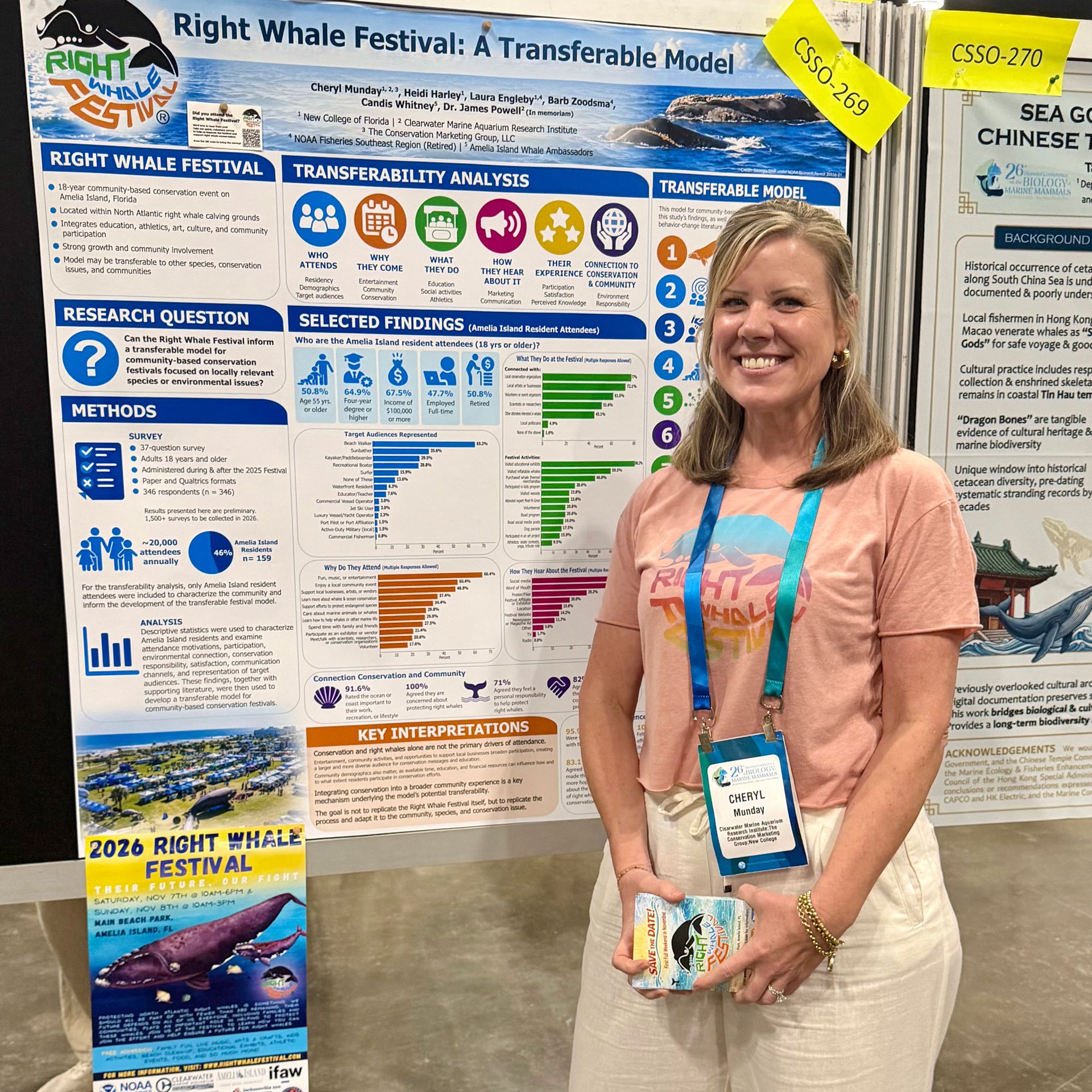
Cheryl Munday presented a case study titled "Right Whale Festival: Building a Whale-Focused Community." That poster won best student poster presentation from North America.
Sarah Farinelli delivered an oral presentation on drone-based monitoring of Florida manatees to inform winter sanctuary management at Crystal River National Wildlife Refuge. Monica Ross, Julia Courville and Nicole Bartlett presented posters examining manatee movements through navigational locks, habitat use in the Ocklawaha River system and the role of natural warm-water refuges in the St. Johns River.
Jamal Galves, based at CMARI's Belize operation, presented rare video of a tiger shark attacking a Greater Caribbean manatee. The footage offered new insights into natural predation on the species.
CMARI researchers also co-authored additional presentations covering manatee acoustics, habitat suitability, physiological stress, movement ecology, detection methods and North Atlantic right whale ecology.
The Right Whale Festival that Munday's award-winning poster examined is organized through CMARI. The festival celebrates the annual return of endangered North Atlantic right whales to coastal waters off northeast Florida and Georgia, where they give birth and nurse their young. Fewer than 380 of the whales remain, according to festival organizers.
The most recent calving season offered some encouragement. The 2025-2026 season wrapped with 23 calves documented, the first time in 15 years that more than 20 were recorded in a single season, CMA reported in May. "These results show what's possible when strong partnerships and conservation measures come together," Melanie White, a CMARI research biologist, said in that report. "Providing a safe environment for mothers and calves during calving season remains essential to the species' future."
The estimated population stands at about 384 individuals, including roughly 70 reproductively active females. The species still faces significant challenges from human-related threats such as vessel strikes and entanglement in fishing gear.
Upcoming
The 2026 Right Whale Festival runs Nov. 7-8 at Main Beach Park, 32 N. Fletcher Ave., Fernandina Beach. Admission is free.