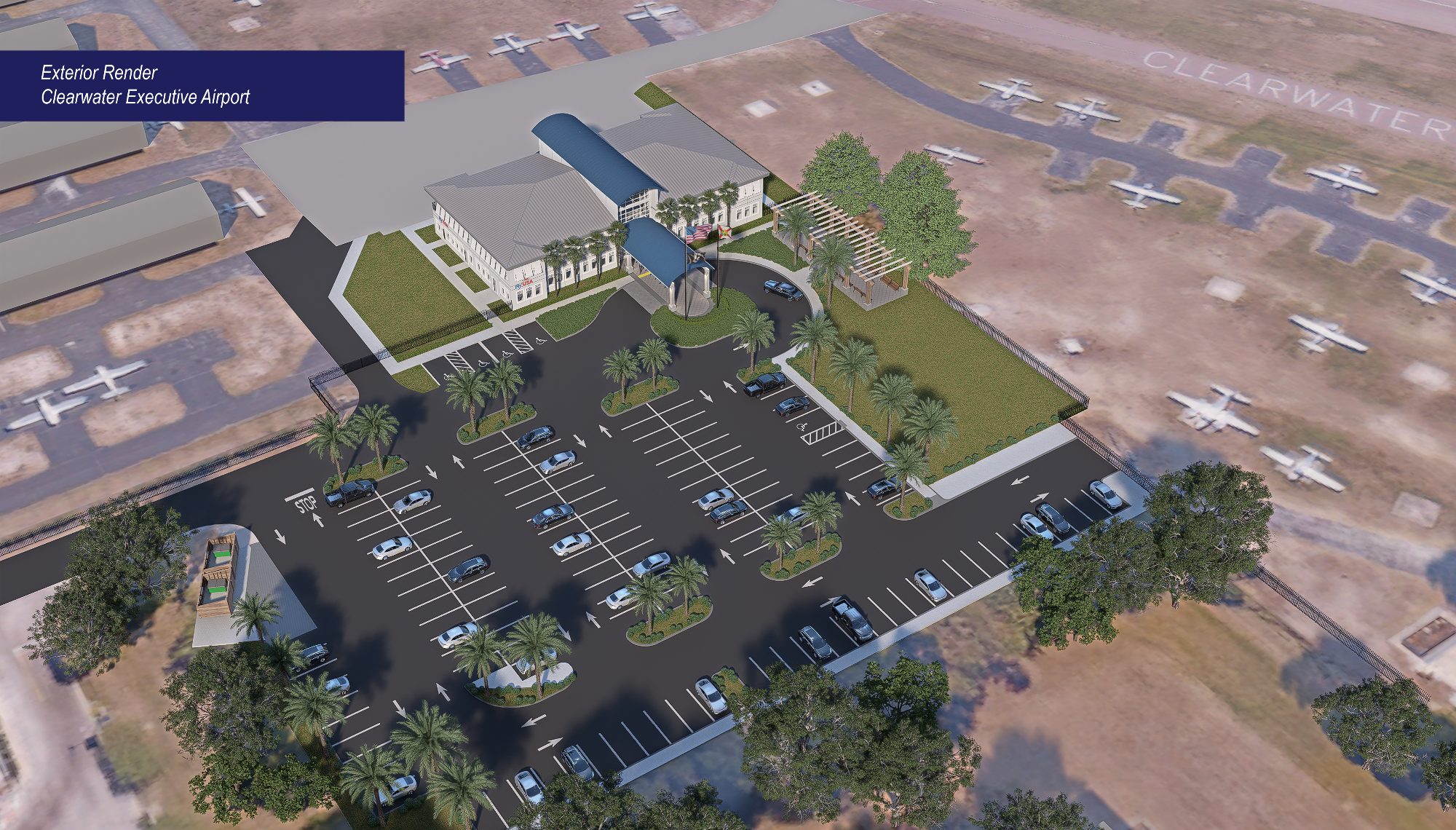
A double-wide trailer has served as the terminal at Clearwater Executive Airport since 2004. On July 17, city leaders and the airport's private operator put shovels in the ground to replace it with an 18,000-square-foot, two-story building that will house a flight school, flight simulator, pilot lounge and corporate offices.
The project carries a price tag of approximately $13.7 million. Clearwater City Council approved the contract with Bandes Construction Co. in March, according to Tampa Bay Business & Wealth, after construction bids came in higher than earlier estimates. Completion is targeted for August 2027.
City Manager Jennifer Poirrier said at the groundbreaking ceremony that the airport will support local businesses, corporate and general aviation, emergency response operations and tourism in the Clearwater area. She called the project a reflection of the city's continued investment in public infrastructure.
The terminal at 1000 N. Hercules Ave. will also become the corporate headquarters of FlyUSA, the Clearwater-based private aviation company that operates the airport as its fixed base operator. FlyUSA CEO Barry Shevlin told Tampa Bay Beacons that the current trailer was built as a "temporary facility" more than two decades ago.
How the $13.7 Million Project Is Being Funded
The Florida Department of Transportation is contributing $3.9 million in aviation grants, part of a total $7.8 million grant program that requires a 50% local match from city of Clearwater capital funds. Under its operating agreement with the city, FlyUSA PV LLC will reimburse the local match share, up to $3.9 million, and cover any cost overruns tied to the grant-funded portion.
The project bundles three components into one build: the terminal itself, a redesigned entrance and parking area, and taxiway improvements. A new hangar is also under construction.
The Joint Venture Running Airport Operations
FlyUSA PV LLC, a joint venture between FlyUSA and St. Petersburg-based Paradise Ventures, began overseeing airport operations in March 2023 after winning the city's request for proposals in 2022. FlyUSA handles aviation operations; Paradise Ventures leads development.
Shevlin co-founded FlyUSA in 2020 with his son-in-law William Holtz, now the company's president and chief operating officer. The firm ranked No. 45 on the 2025 Inc. 5000 list and generates roughly $80 million in annual revenue with 100 employees and 30 aircraft under management, according to a late-2025 South Florida Business & Wealth profile. Shevlin has said he aims to manage 50 aircraft and reach $150 million in revenue by 2027.
"It's something we've been working toward, so it's exciting to finally get it going," Shevlin told Tampa Bay Business & Wealth in March, when the council was preparing to vote on the construction contract.
Airport's History Stretches Back Nearly a Century
Mayor Bruce Rector noted the airport's deep roots at the ceremony, saying the property's history stretches to 1934 and that a historical element from the original airport is still visible on site.
"Aviation has changed over those years," Rector said. "We have gotten a lot of value out of this airport. It operated efficiently. But we haven't made a lot of improvements to it over the years. So, it is so great that we're able to do that now."
The property was originally donated by the Fugazzi family. By the early 1970s it had been converted into a golf course and residential complex, with hangars repurposed as housing units. The city of Clearwater repurchased it in 1980 and renamed it Clearwater Airpark. City Council unanimously restored the Clearwater Executive Airport name in September 2025.
The airport sits 71 feet above sea level, making it the only airport in Pinellas County outside a flood zone. About 125 aircraft are based there on a 4,108-foot runway, primarily piston and turboprop planes used for flight training and regional trips across Florida and the Southeast.


.jpg)