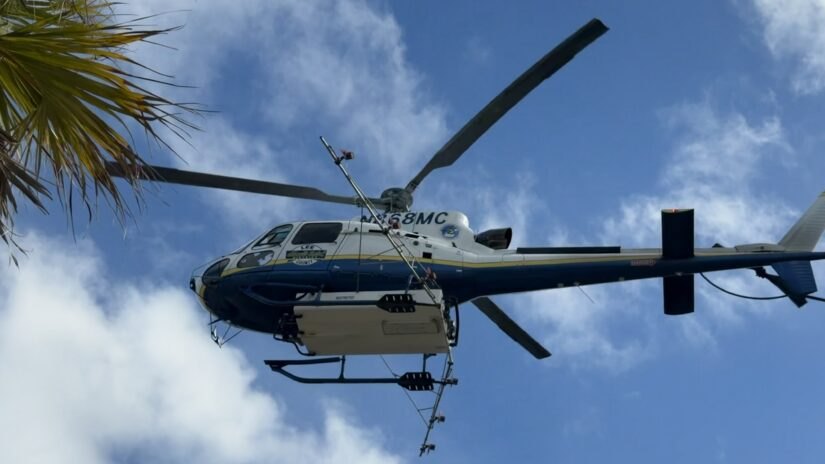
Low-flying helicopters sprayed mosquito larvae treatments over parts of Clearwater and St. Petersburg on Thursday, Nov. 5, as Pinellas County intensified its response to dengue.
Pinellas County Mosquito Control partnered with Lee County Mosquito Control to conduct the aerial treatments between 9 a.m. and 3 p.m., according to a Pinellas County Government announcement. Helicopters were scheduled to begin mapping the St. Petersburg treatment area between 8 a.m. and 9 a.m., before spraying began.
Residents can check designated treatment areas on the county's online mosquito control map by selecting the aerial tab. The county also offers notifications about future treatments.
What they're spraying
The helicopters applied a fine mist of Bacillus thuringiensis israelensis, known as Bti. It is a naturally occurring soil bacterium used to kill mosquito larvae and black flies, according to the county.
Mosquito larvae have a particular gut chemistry that activates the toxin after they ingest Bti. The treatment targets larvae living in standing water before they develop into flying mosquitoes.
Bti is the same active ingredient used in mosquito dunks and bits sold at hardware stores to treat standing water. The county states that the treatment is not harmful to humans, pets or pollinators.
The helicopters fly at low altitudes in repeated patterns to help the mist reach water beneath vegetation and in other difficult-to-access locations. County officials warned residents to expect noise from the aircraft.
Why helicopters
Traditional truck-based treatments cannot efficiently reach every area requiring mosquito control as dengue activity continues.
Aerial treatments allow crews to cover larger areas more quickly, including locations that are difficult for ground vehicles to access.
The county scheduled the Nov. 5 operation during daylight hours to improve flight safety and allow residents to remain indoors if they preferred.
Pinellas County has also continued using ground-based mosquito control equipment, including trucks that target adult mosquitoes and larvae.
Dengue numbers climb
Pinellas County reported 80 locally acquired dengue cases in the latest Florida Department of Health figures, covering the week ending Oct. 31. That was an increase of 13 cases from the previous week's total of 67.
Across Pinellas, Pasco and Hillsborough counties, 491 locally acquired cases have been reported. The figures were detailed in WUSF's Nov. 6 coverage of the latest state surveillance report.
Pinellas County remains under a mosquito-borne illness alert for dengue, with increased mosquito surveillance, inspections and treatments underway.
Dengue spreads through the bite of an infected mosquito. The Aedes mosquitoes responsible can bite during the daytime and reproduce in small containers of standing water around homes and businesses.
How residents can protect themselves
The county urges residents to follow three steps: dump, dress and defend.
- Dump standing water at least once a week. Check buckets, plant saucers, tires, pet dishes and toys around the home. Mosquitoes that spread dengue can breed in small amounts of water.
- Dress in light-colored long sleeves, pants, socks and closed-toe shoes when practical. Dengue-carrying mosquitoes can bite during the day.
- Defend against bites with an EPA-registered insect repellent containing DEET, picaridin, IR3535 or oil of lemon eucalyptus, following the product label.
County crews are also visiting neighborhoods at risk of dengue transmission to help residents identify, empty or treat standing water. Workers will wear Pinellas County uniforms and identification badges.
Residents can sign up for text or email notifications about future aerial treatments through Alert Pinellas.
Additional information about dengue, prevention measures and mosquito control activities is available on the county's dengue information page.