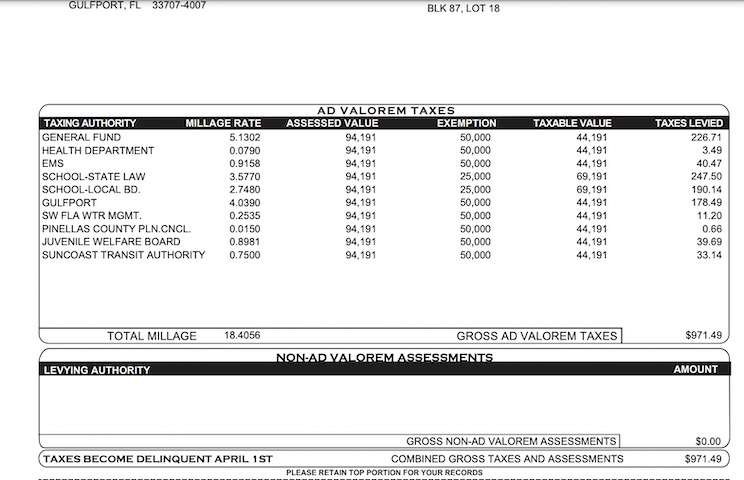
Clearwater-area homebuyers who've been blindsided by property tax bills thousands of dollars higher than what they saw on Zillow or Realtor.com are getting a fix from Tallahassee.
Starting Feb. 1, 2027, Florida home listing platforms must display property tax estimates based on a home's listing price, not the seller's current tax bill. Gov. Ron DeSantis signed the measure into law June 29 as part of House Bill 7031E (Chapter 2026-239).
Pinellas County Property Appraiser Mike Twitty, legislative chair of the Property Appraisers' Association of Florida, helped drive the legislation over multiple sessions.
"Prospective homebuyers deserve property tax information that reflects what they are actually likely to pay — not what the previous owner paid," Twitty said in a July 7 statement posted to the Pinellas County Property Appraiser's website.
Why sellers' tax bills mislead buyers
When a home sells in Florida, the county reassesses it at current market value. The seller's homestead exemption and Save Our Homes assessment cap don't transfer to the new owner.
The result can be sticker shock.
Twitty illustrated the gap in a March 2026 Tampa Bay Times op-ed with two Pinellas County examples. A Largo home listed at $729,900 showed the seller's taxes at $3,276 a year. The estimated buyer's taxes: $11,231, more than 3.5 times higher. A Dunedin townhouse listed at $699,900 showed seller taxes of $2,904, but a buyer would owe an estimated $10,471, more than 3.6 times higher.
The Pinellas County Property Appraiser's office has called the tax gap "the Number One constituent complaint to Property Appraisers across the state for several years running," driven by more than 11 years of rising home values producing the largest Save Our Homes cap benefits since the program began in 1995.
How the new estimate rules will work
Listing platforms that provide a tax calculator must use one of two state-approved methods: the listing price combined with current millage rates following a Florida Department of Revenue formula, or the listing price and the county's aggregate average millage rate, The Gabber reported.
Platforms without a calculator can no longer display the seller's tax bill at all. They must instead direct buyers to the county property appraiser's tax estimator. Printed listing materials face the same restriction.
Platforms may still show the seller's historical taxes as context but must include warnings that tax rates vary within counties, estimates may not include non-ad valorem assessments, and estimates may not account for exemptions or homestead portability.
The Department of Revenue must publish its formulas and each county's average millage rate by Dec. 15, 2026.
Tampa Bay lawmakers pushed the measure through
Sen. Nick DiCeglie, whose district includes part of Pinellas County, filed Senate Bill 856. Rep. Adam Anderson of Palm Harbor filed the House companion, House Bill 827. The Senate passed its version unanimously in February 2026, but the House bill stalled before the regular session ended March 13. Lawmakers ultimately folded the proposal into the broader tax package.
Twitty credited House Ways and Means Chairman Wyman Duggan with incorporating the measure into HB 7031E, calling it "instrumental" in getting the bill to the governor's desk.
What homebuyers should do until the law takes effect
Zillow, which holds roughly half of Florida's online listing platform market share, was already voluntarily using countywide average millage rates in its tax calculator before the law passed, according to the Pinellas County Property Appraiser's office. Twitty noted in March 2026 that Zillow was working to transition to location-specific millage rates for greater accuracy.
Until the law takes effect Feb. 1, Pinellas County buyers can use the property tax estimator at pcpao.gov for a more realistic picture of what they'd owe after closing.




.jpg)